Congratulations on your new role! Whether you are a fresh graduate or transitioning careers, the jump into a corporate environment is often overwhelming. You likely have a million tabs open—literally and figuratively. You might have already experimented with some daily productivity hacks for office beginners, but you’ve probably noticed that quick fixes only go so far when the emails start piling up.
The harsh reality? According to 2025 workplace data, the average office employee is only productive for about 60% of their workday. The rest is swallowed by “work about work,” such as unnecessary meetings, constant Slack pings, and the mental drain of context switching. If you want to stand out as a top performer without burning out by month three, you need more than just “hacks.” You need a comprehensive productivity routine for office beginners. This guide will move you past the basics and into the science of energy management, deep work, and professional boundaries.
Why “Routines” Beat “Hacks” Every Time
Before we dive into the schedule, it is vital to understand the psychological concept of Decision Fatigue. Every small choice you make—Should I check email now? What task is next? Should I take a break?—depletes your finite reserve of mental energy. By establishing a professional daily schedule template, you automate these low-level decisions. This preserves your cognitive “RAM” for the complex, high-value tasks that actually get you promoted. A structured routine ensures that you aren’t guessing what to do next; you are simply following a roadmap designed for success.
Phase 1: The “Pre-Game” Morning Routine (7:00 AM – 8:30 AM)
Your workday doesn’t start at your desk; it starts in your bedroom. An effective morning routine for professionals is about preparing your nervous system for the focus required in an intense office setting.
1. The 30-Minute Screen-Free Rule
The most common mistake office beginners make is checking work emails or social media the moment they wake up. This forces your brain into a reactive mode. Instead of deciding your own priorities, you are immediately responding to the world’s demands.
- The Science: Checking your phone triggers an immediate release of cortisol (the stress hormone), which can lead to “productivity anxiety” before you’ve even had breakfast.
- The Routine: Spend your first 30 minutes hydrating (at least 16 oz of water) and moving your body. Even a 10-minute stretch increases blood flow to the prefrontal cortex—the part of the brain responsible for planning and executive function.
2. High-Protein Fueling
Forget the sugary cereal or the “coffee-only” diet. Your brain requires stable glucose levels to maintain focus throughout a 9-to-5 stretch. A breakfast rich in protein and healthy fats prevents the “insulin spike” that leads to a mid-morning crash, which is a foundational element of any morning routine for career success.
Phase 2: The Calibration Block (9:00 AM – 9:30 AM) (Establishing Your Productivity Routine for Office Beginners)
Once you arrive at the office or log in, don’t just “start working.” You must calibrate your day using proven time management strategies for new employees.
3. The “Big 3” Prioritization
Instead of a 20-item to-do list that feels impossible to finish, identify your three non-negotiables. Ask yourself: “If I only finished these three things today, would I feel successful?”
- The Framework: Use the Eisenhower Matrix to categorize your tasks. As a beginner, you will often find yourself stuck in “Quadrant 2” (Urgent but Not Important) because you want to be helpful to everyone. A strict routine helps you stay in “Quadrant 1” (Urgent and Important), ensuring your energy goes where it matters most.
4. Inbox Triage (Not Inbox Deep-Dive)
Spend 15 minutes scanning for urgent “blockers” from your manager or teammates. Do not start writing long-form replies yet. Use this time to move tasks into your calendar and organize your professional daily schedule template for the hours ahead.
Phase 3: The Deep Work Power Session (9:30 AM – 12:00 PM)
This is your most valuable time of the day. Productivity expert Cal Newport defines deep work for entry-level professionals as activities performed in a state of distraction-free concentration that push your cognitive capabilities to their limit.
5. Eat the Frog: Overcoming Procrastination in the Office
The phrase “Eat the Frog” refers to doing your most difficult, most dreaded task first. Overcoming procrastination in the office is often a matter of momentum. Once the hardest task is out of the way, the rest of the day feels significantly lighter.
- The Depth: Research shows that willpower is like a muscle that fatigues throughout the day. By 2:00 PM, your ability to tackle a difficult spreadsheet or a complex report is significantly lower than at 9:30 AM.
- Implementation: Close your email tab. Put your phone in a drawer. If you use Slack, set your status to “Focus Mode.” Managing office distractions starts with physical barriers.
6. The 90-Minute Sprint
Our brains operate on ultradian rhythms, which are cycles of high-frequency brain activity that last about 90 to 120 minutes. The routine is simple: work intensely for 90 minutes, then take a short break. This aligns with your biology, preventing the “mental fog” that comes from trying to push through for 4 hours straight without rest.
Phase 4: The Mid-Day Reset (12:00 PM – 1:30 PM)
Effective energy management for office workers requires a hard stop in the middle of the day.
7. The 52/17 Rule and Effective Workplace Breaks
A study by the Draugiem Group found that the most productive workers take consistent, effective workplace breaks. The magic ratio was found to be 52 minutes of work followed by 17 minutes of rest.
- Comprehensive Advice: During these 17 minutes, leave your desk. Looking at a screen during your break does not count as rest. Your eyes need to adjust to different focal lengths to prevent “computer vision syndrome,” and your mind needs “diffuse mode” thinking to solve complex problems in the background.
8. The Lunch Protocol
As an office beginner, you might feel pressured to “eat at your desk” to look busy. Don’t do this. It actually signals a lack of time-management skills. A proper lunch break improves afternoon cognitive performance by up to 20%, making it a vital component of a productivity routine for office beginners.
Phase 5: Tactical Afternoon Management (1:30 PM – 4:30 PM)
Overcoming the afternoon slump at work is a biological challenge caused by a natural dip in core body temperature. This is the time to switch from “Deep Work” to “Shallow Work.”
9. Batching Tasks for Efficiency

Context switching—the act of jumping from an email to a report to a meeting—can cost you up to 40% of your productive time. This is where batching tasks for efficiency becomes your secret weapon.
- The Depth: Instead of answering emails as they come in, “batch” them. Set two times in the afternoon (e.g., 2:00 PM and 4:00 PM) specifically for administrative work.
- Application: Group all “quick” tasks together: filing expenses, responding to low-priority messages, and updating your CRM. This keeps your brain in one “mode” at a time.
10. Scheduling Collaboration
Save your meetings for the afternoon. Social interaction provides an external stimulus that can help pull you out of the 3:00 PM energy dip. If you are a new hire, use this time for “Coffee Chats” to build your internal network. Networking is a long-term productivity strategy that pays off in career capital.
Phase 6: The “Shutdown Ritual” (4:30 PM – 5:00 PM)
Most people leave work the moment the clock hits 5:00 PM, leaving their minds cluttered. This leads to the Zeigarnik Effect, a psychological phenomenon where our brains remain preoccupied with uncompleted tasks, making it impossible to truly “relax” at home.
11. The 10-Minute Review & Prep
Before you leave, spend ten minutes on an end-of-day reflection. Clear your desk of physical clutter, as it serves as a visual reminder of “to-do” items. Check tomorrow’s calendar so you don’t wake up with a “jolt” of anxiety, and write down your “Big 3” for the next morning. This “closes the loops” in your brain and marks the end of your professional daily routine.
Comparative Productivity Frameworks
No two office roles are exactly the same, which means your approach to managing tasks should be equally unique and adaptable. Finding the right productivity routine for office beginners often requires experimenting with different methodologies to see what fits your specific workload. You may find that some days require deep, creative immersion while others are dominated by rapid-fire administrative demands and meetings. By testing various frameworks, you can identify which systems help you enter a “flow state” most reliably and which ones feel like a struggle. These frameworks act as the skeletal structure of your workday, providing a clear path forward when the volume of new information feels overwhelming. Below, we have compared the most effective systems to help you choose the best foundation for your evolving professional habits.
| Method | Best For | How It Works |
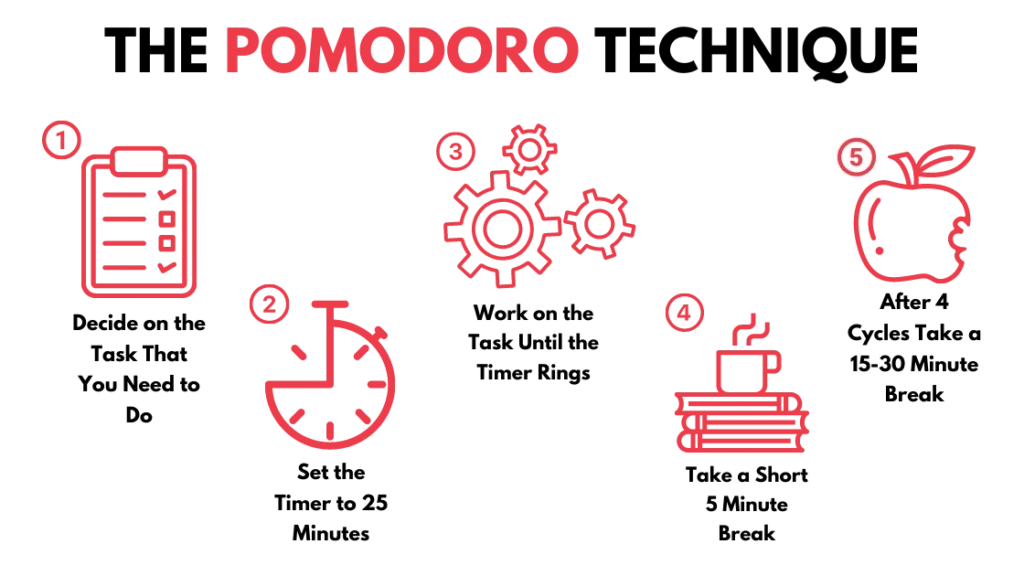
| Pomodoro Technique | Repetitive tasks or high-distraction offices. | 25 min work / 5 min break. |
| Time Blocking | Creative or project-based roles. | Assigning every hour a specific “job.” |
| The Rule of 3 | Avoiding overwhelm. | Identifying only 3 outcomes for the day. |
| Eat the Frog | Procrastinators. | Doing the hardest task at the very start. |
Conclusion
Establishing a solid productivity routine is the single most important investment you can make as you navigate the early stages of your career. It is the bridge between merely surviving your first job and truly thriving within the corporate landscape. By shifting from a reactive mindset to a proactive, science-backed system, you reclaim control over your most valuable asset: your attention. Remember that peak performance is not about sheer willpower; it is about designing an environment and a schedule that supports your brain’s natural rhythms. When you commit to a consistent productivity routine for office beginners, you are setting the foundation for your entire career trajectory. As you implement these phases—from the morning launchpad to the evening shutdown ritual—be patient with yourself. Consistency is far more powerful than perfection, and small adjustments made today will compound into significant professional growth over time. You now have the blueprint to outpace the distractions of the modern office and build a reputation for reliability and excellence. Start with one habit, master it, and then layer on the next until your routine becomes your competitive advantage. Your future self, well-rested and highly accomplished, will thank you for the discipline you cultivate today.
FAQs: Mastering Your Office Routine
Q1: How do I handle constant “ad-hoc” requests from my manager?
Ans: This is the #1 routine-killer for beginners. When a request comes in, don’t say “No,” but do manage expectations. Try this: “I’m currently in a deep-work block for Project X which is due at 4:00 PM. Is this request more urgent than that, or can I tackle it during my admin block at 3:00 PM?”
Q2: Is it okay to use the Pomodoro technique if my coworkers are always talking?
Ans: Yes! Invest in a good pair of noise-canceling headphones. In modern office culture, headphones are often the universal sign for “I am in focus mode; please do not disturb.”
Q3: What if I’m naturally a “Night Owl”?
Ans: While most offices follow a 9-5 schedule, you can still manage your energy. If you peak later in the day, do your “shallow” admin work in the morning and save your “deep work” for 3:00 PM–5:00 PM when you feel most alert.
Q4: How long does it take to turn this routine into a habit?
Ans: On average, it takes 66 days for a new behavior to become automatic. Don’t quit if you have a “bad day” in week two. Simply reset the next morning.

No responses yet